www.evolutionaryethics.comThe
Evolution of Ethics
An Introduction to Cybernetic EthicsThe Evolutionary Process
Social Fission
As education and intellect become more refined, greater order emerges. Evolution is not always planned; sometimes it seeps in where self interest is asleep.
Speculating on how early tribes and societies produced rule systems could probably be better described by historians, but for the purposes of establishing a first approximation of how ethics has evolved from the dawn of civilization until the present, a very general overview will suffice.
Human beings express a wide range of timeless emotions: passion, rage, grief, love, and compassion, to name a few. To this day, people are born immature, uneducated, and inexperienced. Some are intelligent, others slow to learn, some emotionally stable, and some prone to rage. Some individuals mature faster than others, some can understand complex relationships, and others have great difficulty understanding the simplest of things. Given the wide diversity of individual talent and emotional sensitivities, conflicts are inevitable. If conflicts dominate societal attention, vital energies are drained from the creative growth of a society. Constant conflict impoverishes any society.
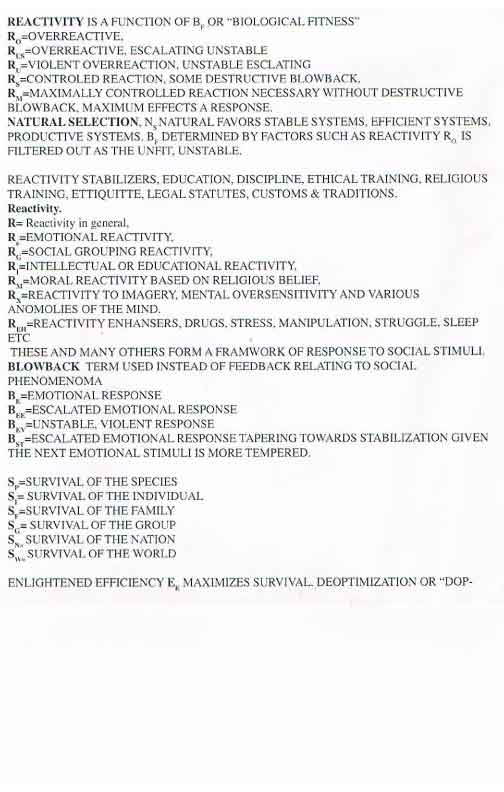
At some point, incessant conflict within a species will threaten its survival. Thus, some regulating systems will arise. Actions inspire reactions that in a primitive environment may be overreactions. Thus, certain delaying mechanisms must buffer emotions and the effects of their excesses. Manners, customs, protocol, and decorum help regulate relationships among people and curb impulsive behavior.
The anarchy that would arise from the chemistry of a group of primitive intellects and emotions in the first moments of building a society would produce certain results. The emotional excesses and predatory habits of people who were not fully reasoning individuals would predictably start conflicts. After repeated conflicts of a similar kind, the nature of conflict might suddenly shift. In some instances, more organization might emerge.
As more people began to move into closer proximity to one another, their untempered emotions would create excesses and overreactions. As the number of overreactions increased, and tempers began to elevate, stress would begin to affect everyone. Given enough stress, some individuals would imagine hostilities where none existed. Mistakes of judgment would proliferate and afflict the society with an exponentially increasing number of reasons to engage in conflict. With an increase in conflict people would begin to yearn for a resolution and for a return to a state of equilibrium. There would be no way to stop the conflicts from intensifying until some benchmark catalysis occurred, since in earliest times no prehistory would have been known that could guide society's actions. Conflict in society would heat up like a nuclear chain reaction. A catalysis would illuminate the source of the conflict and would produce a new rule or attitude to prevent a similar conflict from recurring. Social fission, like nuclear fission, can be initiated under certain conditions. Honest misunderstandings are one condition that can lead to tragic conflict. Systems of etiquette are an example of how rules help minimize misunderstandings by regulating social intercourse through prescriptions of decorum and protocol.
Social fission could be defined in the following way: as the number of people increases in a given area, there is a tendency for those people to establish strong and meaningful relationships that draw individuals residing on the periphery into the midst of a society formulating itself. As the depth and richness of life's experience unfolds in the socializing process, a fascinating tapestry of civilization begins to weave itself. This tapestry becomes the nectar of civilization subtly moving men and women to become dynamically involved. However, a countervailing force, slowing the socializing process, simultaneously evolves from the clashes of human emotions, immaturity, and misunderstanding of a society that does not yet know how to be social. On one hand, people would begin to savor the benefits of being together; on the other hand, they would not know exactly how to be together without getting into conflicts.
Social fission spontaneously follows from the nature of emotions. When resources are scarce, and the closer that primitive emotions come to other primitive emotions, the greater the number of conflicts there will be. Each conflict will inspire more conflicts. Overreactions would create an atmosphere of chaos. For instance, suppose a person's dog bites another person. The second person kicks the dog. The owner of the dog has noticed the kicking but not the biting. The owner hits the bitten person, whose kin happen to be watching. Consequently, tensions rise to the point that several people are killed. It is doubtful that a sensible person observing this would believe that kicking a dog in defense of one's life warrants the tit-for-tat killing of several people. Senseless killing such as this sometimes inspires a grief that raises the consciousness of people, making them aware of the harmful actions they propose to undertake. It could be said, then, that a catalysis of events in a major conflict gives rise to new quanta of social organization.
Conflict catalyses repeatedly occur as the society defines finer and finer details of organization. Social, legal, and moral contracts evolve out of these catalyses. There is something threatening to the whole society, and its ultimate survival, if it finds itself being killed off for little or no reason at all. Grief intensifies the perception of insensibility loose in the world. It is a primitive emotion, yet it can move people toward a better way of organizing their world.