.
Mathematical Concepts Implied in
the Evolution of Ethical Systems
Mathematics seems to permeate the very essence of the many things we call experience. It gives meaning and measure to the physical world. But how can an idea of a particular human behavior be looked at in the same analytical way that water is determined to boil at 100 degrees centigrade? In theory, much of the problem can be attributed to a lack of reliable information concerning a wide array of human actions and their consequent reactions. It is a problem similar to one that chemists faced hundreds of years ago when they were trying to make sense of chemical reactions. Instead of trying to chart the chemical elements, perhaps it is possible to chart human emotions in an organized and meaningful way. Even though there may be thousands, or tens of thousands, of actions and consequent reactions inspiring emotions that result in predictable outcomes, this complexity should be reducible to understandable proportions using mathematics.
When chemistry was becoming a respectable science, there was a growing body of evidence that the physical universe was comprised of a few basic building blocks known as the elements. When these elements were mixed, they produced something entirely different from their component parts. After many years of research it became evident that certain mixtures produced certain results. Once the nature of most of the elements was known, the chemical reaction resulting from a mixture of chemicals could be precisely predicted. The periodic chart of chemical elements did not emerge overnight, rather it evolved by way of hard work from a speculative idea into a respectable science.
Except at the theoretical fringes, the mathematics of elemental relationships is more or less exact and reproducible. On the other hand, the mathematics associated with sociology, psychology, and economics is much less exact. The former, chemistry, is called a hard science and the latter categories, soft sciences. The soft sciences are not usually held in the same esteem as the hard sciences. This is perhaps because they cannot be pinned down to any notable degree of consistency, verifiability, and exactness. While many people would like to believe that there are solid mathematical connections to these disciplines, their reputation for overstatement and inaccuracy leads many hard scientists to harbor a healthy skepticism. Thus, to posit that mathematical principles lay at the foundations of evolving ethical systems would land even a good theory on already contentious grounds.
It is one thing to theorize that mathematical relationships exist, and another to produce the mathematics themselves. Human behavior encompasses such a wide spectrum of activity that it would take an immense effort to quantify all possible behaviors. At present, one can only paint in broad terms simple relationships that appear to exist between mathematics and human behavior. Still, there are some tangible relationships that can be established. For example, one could begin by analyzing the influence of money on human behavior. Lending money is a fairly common practice, often producing a predictable outcome as one views it from hindsight. Mathematically expressed in terms of many conditions and variables, the dynamics of lending money are quite complex. A simple query might go as follows: Given that it is reasonably constant that money can corrupt, alter, or influence the good intentions and professional work of even the finest humans, what is the mathematical relationship between lending a variable sum of money and receiving a timely and trouble- free repayment of that money, given a diversity of conditions and people under which the loan was made?
What is important here is the fact that relationships can be established between specific behaviors and the outcome of events linked to those behaviors. The conventional approach to analyzing such relationships is to rely on a statistical analysis of actions and events. But thinking of relationships solely in terms of statistics overlooks the deeper and more subtle concepts implied in the living language of relationships.
A mother does not need to know the precise statistics about how many children are injured or abducted while playing in an unsupervised environment. She only needs to know that a significant relationship exists between her caring for her child and the avoidance of many types of harm that children can encounter. She may not be able to communicate effectively why she knows such a relationship exists, but at the same time she may possess real knowledge of the human condition. It is one thing to understand by experience that certain relationships exist between actions and events. It is another thing to be able to convey that knowledge to others in a clear and understandable way.
Even though most people cannot articulate complex ideas in an understandable way, they often find a common bond of knowledge and experience by adopting values, morals, and cultural sentiments that express their ideas and experiences effectively. Thus, cultural moralisms and the sentiments that accompany them, often give people reasonable cause to discourage behaviors which they consider harmful. These "moralisms" can be thought of as simplifying abstractions of complex relationships that generations of experience have determined time and again lead to trouble. If one thinks of the evolution of specific moral sentiments as functional abstractions of complex human interactions, then it should be easy to see how useful they are in everyday life for making fast and trouble-free choices.
The language of social cybernetics is reflected in the very idea of human relationships. The world of interpersonal relationships is a dynamic, give-and-take situation. Human relations possess a living ambience, that involves real, multidimensional activities. A statistical analysis of those same relationships is often devoid of the wide spectrum of subtle interactions necessary to make the dissemination of large quantities of complex information possible in a short time. Given that the mathematics of human relations involves something more than dry statistical numbers, it might follow that mathematical analysis would be better served by focusing on the mathematical nature of relationships instead of the numbers. Statistical numbers are, of course, relevant in the assessment of relationships, but not so much so that the essence of what one is trying to communicate is lost.
Unedited Notes on some cybernetic variables to be discussed later
Conflicts escalate based on IP
The evolution of ethical systems suppress and stabilize conflicts by breaking the escalating cybernetic loops that cause conflicts to go out of control. Stable systems experience peace, prosperity, and productivity where unstable systems on the other hand can experience pain, suffering and death. Human survival is maximized by the evolution of rules to prevent destructive feedback in stressful situations.
IP=Initial Point of Conflict. Conflicts start somewhere. Weaknesses of personality, greed, emotions, immaturity and the like, are sources of conflict. For instance, when a client or business person begins to leverage more than their fair share of a business agreement an initial point of conflict arises. When terms of an agreement are violated their is an initial point. When an client or business person becomes aggressive or overly assertive there is an IP. Once an initial point is established, how the two parties subsequently react to the establishment of an IP depends on their emotional, social and intellectual reactivity.Types of reactivity:
Reactivity: The intensity of response to environmental stimuli, either IP response in a conflict or a reinforcement and perpetuation of an IP (initial point of a conflict), escalation or escalation of an emotional situation). IPe escalation IPd deescalation, IPnneutralizingReactivity is a function of Bf. or Biological Fitness. Note: in conflict analysis one cannot assume the stimuli comes only from a social situation there also should be considered a genetic variable that randomly occurs, a phantom stimuli (perhaps fitness self-test stimuli), that sets off conflicts. Ettiquitte, education, customs and traditions help supress phantom stimuli Sph
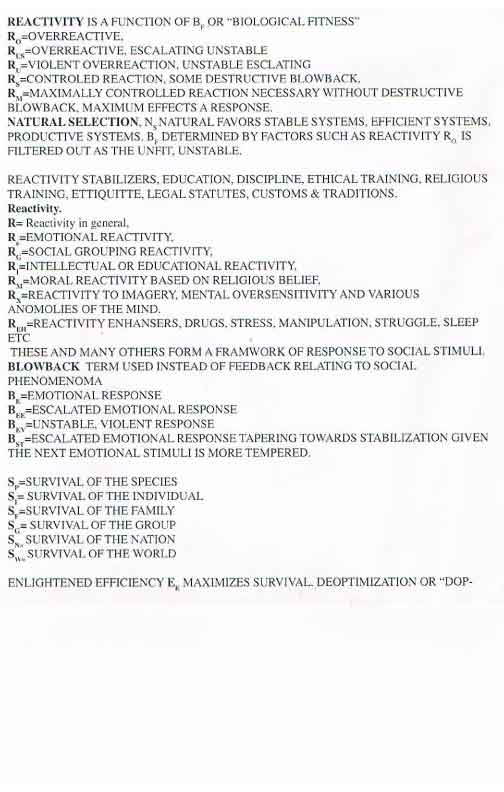
Ro=Over reactive,
Rus=Over reactive, escalating towards unstable
Ru=Violent overreaction, unstable escalating
Rs=Controlled reaction, some destructive blowback,
Rm=Maximally controlled reaction necessary without destructive blowback, maximum effects a response.
Natural Selection, Ns Natural favors stable systems, efficient systems, productive systems. Bf determined by factors such as Reactivity Ro. is filtered out as the unfit, unstable. Reactivity stabilizers, education, discipline, ethical training, religious training, etiquette, legal statutes, customs, traditions.
Reactivity.
R= Reactivity in general (response reactivity)
Re=Emotional Reactivity,
Rg=Social Grouping reactivity,
Ri=Intellectual or educational reactivity,
Rlrel=Moral reactivity based on religious belief,
Rx=Reactivity to imagery, mental over sensitivity and various anomalies of the mind.
Reh=Reactivity enhancer, drugs, stress, manipulation, struggle, sleep etc
These and many others form a framework of response to social stimuli.
Blowback Term used instead of feedback relating to social phenomenon
Be=Emotional response
Bee=Escalated emotional response
Bev=Unstable, violent responseBst=Escalated emotional response tapering towards stabilization given the next emotional stimuli is more tempered.
Sp=Survival of the species
Si= Survival of the individual
Sf=Survival of the family
Sg= Survival of the group
Sn= Survival of the nation
Sw=Survival of the world
Enlightened efficiency Ee maximizes survival. deoptimization or “doping”requires some forms of inefficiency to be present in an efficient human social system.
Given: A finite balance must be maintained between variables such as....Evolution moves social progress in the direction of stable systems to facilitate human survival. Mechanisms evolve to delay conflicts from escalating by suppressing reaction time.
REdt = Reaction Delay Time
Reaction delay time can be seen as a function of education, emotional discipline, social wisdom (i.e. knowing how emotional interactions work) professional and legal codes and the like. There is a mathematical relationship between escalating conflicts and fast reaction times. Etiquette, customs, professional codes, traditions and religious training all encourage thoughtful responses to tense confrontations inspiring the creation of stable business enterprises and social systems.
Ethical evolution, Eev, is a counter force to social decay Ds. A good way to visualize this is to think of the laws of physics. The second law of thermodynamics describes the natural breakdown of physical systems. In social systems the same thing occurs. Social, economic, and political systems tend to decay with time. The function responsible for this is C for chaos. If a political, economic or political system is not refined, maintained or upgraded it falls into chaos. An example of this can be seen in the evolution of street gangs and criminal enterprises. The society not being well-maintained or upgraded currently ignores the growing problem of crime. Accretion, Acc , sets in. The rise in crime is so gradual the political will to stop its growth is never inspired. Thus, the society gradually falls into a form of social decay, because no counter force exists to stop it. Since the growth is so imperceptible few notice when the evolution of crime meets the tipping point Dtp where C estasblishes itself and overcomes Eev as a percentage of the distribution of power in a society.Social Power
Social Currency
From the book The Evolution of Ethics: An Introduction to Cybernetic Ethics
.
HOME PAGE www.evolutionaryethics.com
.
. 6/09/08moral science